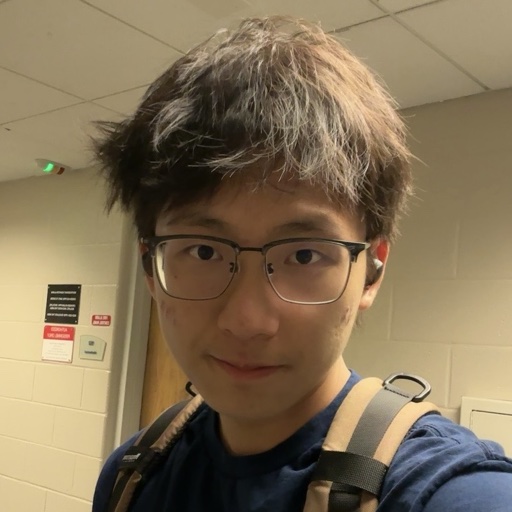
Chenhao Liang
Software Engineer | AI Backend Systems
M.S. Computer Science @ USC · Seeking Summer 2027 SWE Internship
Software engineer building LLM-powered backend systems: agents, retrieval, and fault-tolerant services on AWS. Seeking Summer 2027 SWE internships.
160K+
profiles ranked
22s → 0.2s
insights latency
11,800+
tickets processed
83% → 96%
AI reply success
−77%
P95 checkout latency
Capabilities
About Me
I am a software engineer who builds the backend systems behind LLM products: agents that turn conversations into structured data, retrieval and ranking pipelines, and services that stay reliable when model calls are slow or fail. I mostly work in TypeScript, Java, and Python on AWS.
At Figwork, I am building the hiring-spec agent and candidate matching backend for an AI recruiting platform, including a recommendation system over 160K+ profiles and an insights path I cut from 22s to 0.2s. At Segi, I built agent workflow and message-ingestion services for an enterprise property-management platform that processed 11,800+ tickets, and raised AI reply success from 83% to 96% under load.
I am an M.S. CS student at USC (GPA 4.0), co-first author of CUA-SWE (under review at ICLR 2027), and I am looking for Summer 2027 software engineering internships.
Selected Engineering Work
Systems I designed or built end to end, with the problem, the approach, and the measured result.
Two-Stage Candidate Recommendation
2026Figwork · AI Recruiting Platform
Problem: Recruiters describe roles in free-form chat, and matching them against 160K+ candidate profiles had to be both relevant and fast.
- Built the agent that converts a recruiter's chat into a structured hiring spec over a 106-field job schema.
- Co-architected embedding recall followed by LLM reranking, with online preference learning from like/skip feedback and cold-start exploration.
- Migrated retrieval to pgvector and added caching plus an incrementally refreshed inverted index, cutting insights latency from 22s to 0.2s.
Enterprise AI Support Backend
2025Segi · Property Management Platform
Problem: AI customer support for 3 enterprise clients across 60+ properties had to handle WhatsApp/WeCom traffic without losing messages or failing replies under load.
- Designed a modular agent workflow engine (Spring Boot + LangChain4j) with reusable nodes and conditional routing for intent recognition, parallel multi-query RAG over Milvus, and MCP tool calls.
- Built multi-tenant message ingestion with Redis per-tenant locks, TTL deduplication, and DB-backed cursor recovery.
- Added bounded thread pools, timeouts, retries, circuit breaking, fallbacks, and RabbitMQ buffering, raising AI reply success from 83% to 96% in 200+ concurrent load tests.
- Processed 11,800+ tickets and cut ticket creation time from 2 minutes to under 30 seconds.
NextTier: AI Custom Merchandise Platform
2026Industry Project · Project Lead
Problem: An AI design-to-order product needed a backend that stayed fast under load and kept model costs under control.
- Built and deployed React + FastAPI microservices on AWS covering design generation, product previews, and ordering, validated with 500 simulated end-to-end workflows.
- Added Redis caching over PostgreSQL, reducing database reads by 69% and API latency by 32%.
- Moved checkout onto an Amazon SQS pipeline, cutting P95 checkout latency by 77% at 100 concurrent users with under 1% failures.
- Guarded AWS Bedrock calls with request validation and duplicate-request protection.
Selected Research
Research on LLM agents and robot learning.
CUA-SWE: When Computer-Use Agents Meet Visual Software Engineering
2026Co-first Author · FORTIS Lab, USC · Under review at ICLR 2027
Benchmarks when computer-use agents, which see and operate a browser, beat code-only agents on visual web bugs. Curated 33 web repair tasks from real GitHub issues and built deterministic behavioral verifiers to diagnose partial repairs and failure modes.
FELT: Generating Tactile Signals from Vision
2026Co-author · RSS 2026 Workshop on Tactile Sensing
Generates tactile signals from visual observations so robots can learn visuo-tactile manipulation without dense tactile sensing.